


Ballpoints are for forms. Fountain pens are for correspondence and journaling. Rollerballs sit in the middle — smoother than ballpoints, less maintenance than fountain pens. For daily writing at a desk, the choice between a fountain pen and a rollerball is real, and the right answer depends on your writing volume, your tolerance for maintenance, and how much you care about how the writing looks.
This guide compares fountain pens and rollerballs head-to-head across daily writing scenarios — office notes, journaling, longhand drafts, and correspondence — and shows which context favors which pen. Reference setup: the Wordsworth & Black fountain pen line against a typical premium rollerball at the same price point.
Key Takeaways
- Fountain pens win on hand comfort during long sessions, expressive line character, and cost per page over the long term
- Rollerballs win on zero-maintenance daily use, consistent line width regardless of technique, and paper flexibility (works better on cheap office paper)
- For writing sessions under 15 minutes/day, a rollerball is often the more practical choice; for 30+ minutes/day, the fountain pen pays back in comfort within weeks
- The Wordsworth & Black Crest Set at $39.99 costs less than most premium rollerballs and delivers a fountain pen experience with five interchangeable nibs
- Best daily desk configuration: fountain pen for writing that matters, rollerball for quick notes and forms — the two complement rather than compete
How Each Pen Works
Fountain Pen
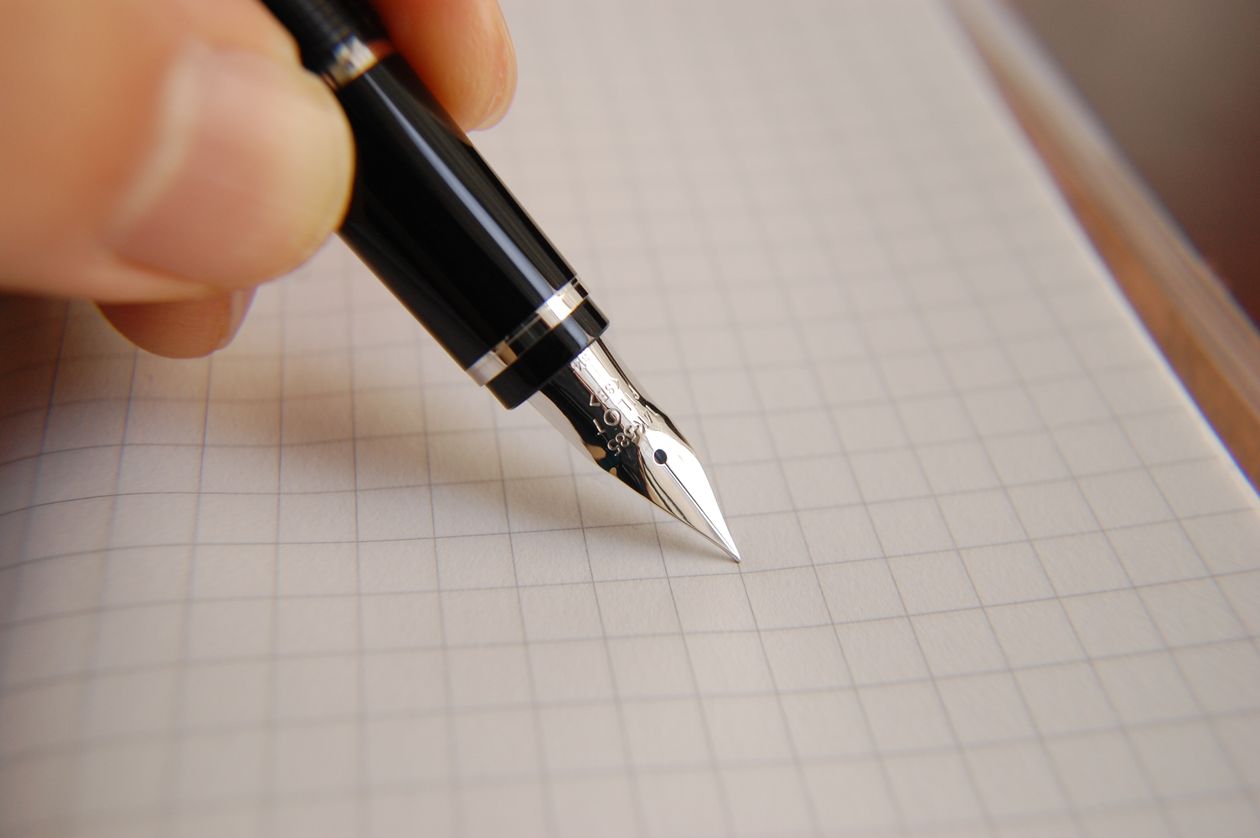
Water-based dye ink flows via capillary action from an internal reservoir (cartridge, converter, or piston) through a fluted feed to the nib. The nib glides on iridium tipping; ink flows out as fast as the paper absorbs it. You provide no downward pressure — only direction.
Rollerball
Water-based or gel ink held in a sealed refill cartridge. A small tungsten-carbide ball at the tip rotates as you write, picking up ink from the cartridge and depositing it on the paper. Because the ink is thinner than ballpoint ink, less pressure is required — but more than a fountain pen.
The key mechanical difference: fountain pens are open-flow systems (nib touches paper, ink flows), while rollerballs are pressure-triggered systems (ball must roll to release ink). That single difference shapes every downstream property.
Head-to-Head Comparison
| Variable | Fountain Pen | Rollerball |
|---|---|---|
| Pressure required | Very low (~5–10 g) | Low (~40–80 g) |
| Line width variability | High (nib size + pressure) | Fixed by refill |
| Dry time | 7–15 seconds | 5–20 seconds |
| Paper sensitivity | High (needs 80+ GSM) | Medium |
| Maintenance | Flush every 4–8 weeks | None (change refill) |
| Cost per page (5 yr) | ~$0.005 (bottled ink) | ~$0.035 |
| Initial cost | $40 (Crest Set) | $4–$60 depending on brand |
| Best for | Extended writing, expression | Quick notes, low maintenance |
Where Fountain Pens Beat Rollerballs
Long Writing Sessions
The pressure difference matters most over time. Writing for 30 minutes with a rollerball produces noticeable hand fatigue for most people; writing for 30 minutes with a fountain pen doesn't. Journalers, students in exam blocks, and anyone drafting longhand feels this within the first week of switching.
Expressive Line Character
Fountain pen nibs — especially the Stub option in the Crest Set — produce line variation that no rollerball can replicate. Downstrokes and cross-strokes have different widths; letters have character; handwriting looks considered rather than mechanical. For anything you'll re-read (journals, letters, signatures), this matters.
Long-Term Cost
A $40 Crest Set with a $13 bottle of bottled ink costs about $0.005 per page over five years — half a cent. A premium rollerball with refills costs about $0.035 per page. Over five years of daily writing, that's a 7× difference. Ownership economics favor the fountain pen decisively.
Maintenance as a Feature
The rollerball's zero-maintenance advantage is real — but the fountain pen's small maintenance ritual is what turns the pen into a habit. Owners flush fountain pens every 4–8 weeks; that small routine keeps them using the pen. Rollerballs get forgotten in drawers.
Our take: "Better" depends entirely on what you write and how much. A rollerball is objectively more convenient for someone who writes 2 minutes a day. A fountain pen is objectively better for anyone who writes 20+ minutes a day. Match the tool to the writing volume, not the other way around.
Where Rollerballs Beat Fountain Pens
Consistent Flow on Any Paper
Rollerballs work on cheap 70 GSM office paper without feathering. Fountain pens don't — they feather visibly on cheap paper, especially with Medium and Broad nibs. If you write on whatever paper is available (meeting handouts, receipts, backs of envelopes), a rollerball produces cleaner results.
Instant Readiness
A rollerball uncaps and writes. A fountain pen that's been sitting for a week may need a tap or a short flush to start flowing consistently. For quick-note contexts (a phone call where you need to jot down a name in 5 seconds), the rollerball is more reliable.
No Storage Considerations
Rollerballs don't care how they're stored. Fountain pens need to be capped tight and stored nib-up to prevent leaks. In a chaotic bag or a car cup holder, a rollerball survives; a fountain pen risks an ink incident.
Zero Cleaning Time
The 10 minutes every 4–8 weeks to flush a fountain pen is real time. If that time is genuinely unavailable — parents with newborns, medical residents, high-intensity job periods — a rollerball removes the maintenance without removing the ability to write.
Which Context Suits Which Pen?
Journal, Letters, Longhand — Fountain Pen
Extended writing on quality paper is exactly what fountain pens are designed for. Comfort, expression, and cost per page all favor the fountain pen. The Crest Set with the Stub nib and Racing Green ink is the setup we'd hand any journaler.
Office Notes, Meeting Minutes — Rollerball (Often)
The unpredictable paper situation in most offices (whatever's in the printer today) makes rollerballs the pragmatic choice. If you can bring your own quality journal to meetings, the fountain pen wins here too — but if you're writing on random handouts, rollerball behaves better.
Signatures, Formal Documents — Fountain Pen
Signatures with a fountain pen — especially the Majesti Gold's 18K gilded nib — look distinctive in a way rollerball signatures never do. For legal documents, contracts, and important correspondence, the fountain pen adds gravitas.
Field Work, Travel, Rough Conditions — Rollerball
Fountain pens survive travel but demand attention (nib-up storage, avoid pressure changes with partially filled cartridges). Rollerballs don't care. For field notes, backpack pens, or car glove-compartment pens, rollerball is the safer choice.
Studying, Note-Taking — Depends on Volume
Under 15 minutes/day of note-taking: rollerball is fine. Over 30 minutes/day (extended study blocks, exam prep): fountain pen for hand comfort. Between 15 and 30 is the honest gray zone.
Cost Per Page: The Five-Year Math
| Setup | Initial | Refills (5 yr) | Total | Per Page |
|---|---|---|---|---|
| Disposable rollerball | $5 | ~$60 | $65 | $0.036 |
| Refillable rollerball (premium) | $40 | ~$60 | $100 | $0.055 |
| W&B Crest + cartridges | $40 | ~$80 | $120 | $0.066 |
| W&B Crest + bottled ink | $40 | ~$48 | $88 | $0.005 |
The economic winner is unambiguous: fountain pen with bottled ink. Even accounting for the initial pen cost, five years of daily writing costs less than any rollerball option — including disposables.
The caveat: this only works if you actually flush and refill the pen. Owners who buy a fountain pen and then use cartridges exclusively see a higher per-page cost than a rollerball with refills.
The Fountain Pen + Rollerball Combination
The best daily writing setup isn't either — it's both. A fountain pen for writing that deserves the fountain pen (journal, letters, signatures) and a rollerball for everything else (quick notes, forms, backpack pen). The two complement rather than compete.
The Split Setup
- Desk pen: Wordsworth & Black Crest Set with Medium or Stub nib, loaded with Royal Blue or Racing Green bottled ink
- Bag pen: A rollerball for quick notes, forms, whatever paper appears in your day
- Milestone pen: Majesti Gold on the desk for signatures and important letters
Total investment: about $50–$100 depending on the rollerball choice. Covers every writing context a normal week produces.

Making the Switch: If You've Only Used Rollerballs
Most rollerball users don't realize how much hand pressure they're using until they try a fountain pen. Two weeks is enough to feel the shift.
Week 1: Grip Adjustment
Hold the fountain pen with the same grip you use for a rollerball. Notice how much lighter you can hold it. Consciously relax your grip through the first 20 minutes of each writing session — the pen still writes.
Week 2: Pace Adjustment
Fountain pens naturally slow you down slightly. Don't fight it. The slower pace is what produces the expressive line character; the writing looks better than it did with the rollerball.
Week 3: Consider a Second Ink Color
Rollerballs typically come in one or two colors per refill. A fountain pen with bottled ink lets you switch colors permanently. Try a second bottle from the Wordsworth & Black bottled ink line for a second pen or a color rotation.
Week 4: Reassess
By now the fountain pen either "clicks" or doesn't. Most rollerball switchers report the pen sticks — the hand-comfort advantage is real. If it hasn't clicked, examine setup: nib size (try Fine if you've been on Medium), paper quality (upgrade to 100 GSM), and grip (loosen).
Frequently Asked Questions
Should I sell my rollerballs if I get a fountain pen?
No. The two complement each other. Keep the rollerball for the contexts where it wins (quick notes, forms, travel) and use the fountain pen for the contexts where it wins (journal, letters, extended writing). Neither replaces the other.
Is a $40 fountain pen better than a $40 rollerball?
For extended writing — yes, by a wide margin. For quick daily notes on cheap paper — no, they're roughly equivalent. Match the pen to the primary use case.
Can I use fountain pen ink in a rollerball?
No — the mechanisms are different. Fountain pen ink is thinner and flows freely; rollerball refills are specifically formulated for their rolling-ball mechanism. Don't cross the two.
Which pen is better for left-handed writers?
Rollerballs are generally more forgiving because they dry faster than most fountain pen inks. But a fountain pen with a Fine nib and fast-drying ink (like Royal Blue from our line, ~11s dry time) works excellently for left-handed writers. See our left-handed fountain pen guide for the full setup.
What about ballpoints?
Ballpoints belong in a different category — they require far more pressure (150–200g vs 40–80g for rollerballs) and are less comfortable for extended writing than either fountain pens or rollerballs. Use ballpoints for what they're good at: forms, carbon copies, rough conditions.
How long does a rollerball refill last vs a fountain pen fill?
Roughly comparable: 200–300 pages of A5 writing per refill/fill. Over a year of daily use, both need about 4–5 refills.
Is fountain pen maintenance really only 10 minutes every 4–8 weeks?
Yes. A flush is 5–10 minutes of active work plus overnight drying. That's the entire routine. Deep cleans (24-hour soaks) are rare and only needed if you skip routine flushes for many months.
Final Verdict
For daily writing at a desk, the fountain pen beats the rollerball on hand comfort, expressive line character, and long-term cost. The rollerball beats the fountain pen on zero-maintenance convenience, paper flexibility, and travel reliability.
The optimal setup is both: a Wordsworth & Black Crest Set on the desk for writing that deserves the fountain pen (journal, letters, signatures), and a rollerball in the bag for quick notes and unpredictable paper. Total investment for this combined setup: about $50–$100.
If you must pick one — and you write more than 15 minutes/day on quality paper — buy the fountain pen. The hand-comfort advantage compounds daily; the long-term cost is lower; and the writing looks better on the page. The rollerball's convenience matters most for people who barely write at all, in which case the choice barely matters either way.
→ Browse the full Wordsworth & Black Fountain Pen Collection